Please check our "Frequently Ask Questions" in case this already contains an answer to your question. Alternatively, you may select your prefer method of contacting us from available categories below.
Frequently Asked Questions
What Does the Bible Say About ...?
The following list contains answers to some common questions asked. If you cannot find the answer to your question here, please check in Contact Us tab.
- Use below links to jump to detais of common FAQ items segments:-
- What is the difference between Evangelism and Witnessing?
- What is 1st and 2nd death?
- What is the difference between a promise and a vow (to God)?
- Are we still under the 10 commandments?
- What does it mean to be 'too holy'?
- What is worldliness?
- If all things are created by God, does this mean that he creates evil?
- What does the Bible say about divorce and remarrying?
What is the difference between Evangelism and Witnessing?
‘ ... go and make disciples of all nations ... teach these new disciples to obey all the commands ...’ Matthew 28:20
Evangelism is to preach or teach God’s Word. When a Christian becomes deeply grounded in God’s Word, he is equipped to evangelise about what the Bible says and means.
‘..."just come and see for yourself ... you will see greater things than this." ' John 1:43-46
‘..."Come and meet a man who told me everything I ever did!"...' John 4:7-30.
‘... "I think he must be a prophet ... I know this: I was blind and now I can see!"...' John 9:1-25
Witnessing is a personal testimony, an account of what God has done for that person, whether they are a Christian or non-believer. It is testimony of what they have experienced or seen in their life.
When a young convert becomes more grounded in God’s Word then they will move onto evangelising. A non-believer may also convert as a result of witnessing God’s work as illustrated in John 9:26-39. ‘..."Yes, Lord", the man said, "I believe!" And he worshipped Jesus.’ John 9:38
What is 1st and 2nd death?
Before distinguishing between the two states of death, it should be noted that the Bible uses the term ‘sleep’ when referring to the physical body at death (of a believer). This is because the dead body appears to be asleep when it is separated at death from the spirit. Physical death can also be regarded as the 3rd death.
1st Death – Occurred in the Garden of Eden, where Adam and Eve became spiritually separated from God. They had disobeyed God’s warning not to eat fruit from the tree of knowledge and therefore committed a sin. As a result, we all inherited their sin and became spiritually separated from God. The 1st death can be seen as being a spiritual separation – spiritually dead to God.
2nd Death – Occurs at the end of all time, on Judgement Day, where all sinners will be separated from God eternally. ‘... their doom is in the lake that burns with fire and sulphur. This is the second death'. Revelation 21:8. ‘You were dead because of your sins and because your sinful nature was not yet cut away. Then God made you alive with Christ. He forgave all our sins.’ Colossians 2:13
During the period between been born into sin (inheriting Adam and Eve’s sin) and Judgement Day, there is an opportunity to regain a spiritual connection with God. The extract from Colossians illustrates how becoming a Born Again Christian changes a sinner from being spiritually dead to alive.
If a person does not believe in God i.e. becomes a Born Again Christian, they are already dead to God. Living a sinful life separates man from God and so we are all faced with the choice of being dead in sin or possessing eternal life.
‘...Our aim is to please Him always ... For we must all stand before Christ to be judged. We will each receive whatever we deserve for the good or evil we have done in our bodies.’ 2 Corinthians 5:8
What happens to the spirit after physical death?
‘... the body is dead without a spirit ...’ James 2:26 and ‘Stephen prayed, “Lord Jesus, receive my spirit.” ... and with that, died’ Acts 7:59
Stephen’s death illustrates the Bible’s first Christian death. As with Stephen, a Born Again Christian’s body is ‘asleep’ whilst the spirits returns to God. There it resides until God casts judgement and restores His kingdom at the appointed time.
‘...how long will it be before you judge the people who belong to this world ...?’ Revelations 6:9-11
What is the difference between a promise and a vow (to God)?
‘...when you make a promise to God, don’t delay in following through, for God takes no pleasure in fools. Keep all the promises you make to him’. Ecclesiastes 5:4-5
From man’s perspective, a promise is an understanding to do (or not to do) something. A vow represents a solemn commitment to do (or not to do) something. Each aspect creates its own level of expectation that whatever has been promised or vowed will be done.
In biblical terms, very little distinction is made between the two. In an Old Testament example Nehemiah 5:13 illustrates the children of Israel making a promise: ‘If you fail to keep your promise, may God shake you from your homes ... The whole assembly responded, “Amen” ... the people did as they promised’. In the New Testament, Matthew 5:33-37, we see an example of a vow made to God: Do not break your vows, you must carry out the vows you have made to the Lord ... Your word is enough ... To strengthen your promise with a vow shows that something is wrong’.
As a Christian, your ultimate aim is to be true to God’s Word. Whether you give your word as a promise or a vow, you should be true to whatever is said.
Are we still under the 10 commandments?
‘The old system in the law of Moses was only a shadow of the things to come ... sacrifices under the old system were repeated ... but ... were never able to provide perfect cleansing ... that is why Christ cancels the first covenant in order to establish the second ... for us to be made holy by the sacrifice of the body of Jesus Christ once for all time’. Hebrews 10:1-10.
The 10 commandments were intended to guide the children of Israel in their spiritual and moral behaviour. However, their constant disobedience of God’s Laws (as given through Moses) resulted in a new way being given i.e. through Jesus Christ.
‘The law was our Guardian and teacher to lead us until Christ came. So now, through faith in Christ, we are made right with God’. Galatians 3:24-25
‘Now we can really serve God, not in the old way by obeying the letter of the law, but in the new way by the Spirit.’ Romans 7:6
No longer were people bound by God’s Law but by faith in Jesus Christ who had come to deliver them from their sins and so it is the same for Christians today.
Whilst the 10 commandments have been replaced by a commitment to have faith in Jesus Christ, the laws are still relevant today. When Jesus was asked about the most important of God’s law, he gave two ‘... love the Lord ... love they neighbour ...’ Matthew 22:34. By abiding in these two laws, the 10 commandments are effectively covered.
What is important to note is that Jesus came to take away the first set of laws and establish the second. However, we are still under Gods laws today.
What does it mean to be 'too holy'?
‘I am sick of your sacrifices ... why do you keep parading my courts with your worthless sacrifices ... your celebrations ... are all sinful and false ... even though you offer many prayers, I will not listen’ Isaiah 1:11-15
Following the structure of Christianity too rigidly and seriously without heartfelt joy can be considered as ‘too holy’. Relentless study without conviction or meditation is also being ‘too holy’.
Christianity requires a balance of seriousness and jubilation; a combination of understanding God’s Word and thanksgiving for what He has done.
Psalm 150:1-6 ‘Praise God ... praise Him ... let everything that lives sing praises to the Lord’ 2 Samuel 6 ‘... all the people of Israel were celebrating before the Lord with all their might’. Both these scriptures show us the joyfulness which comes from knowing the Lord.
It is important to know God through His Word with meditation and application. It is also important to praise Him for all he has done.
What is worldliness?
‘...when you love the world, you show that you do not have the love of the Father in you. For the world offers only the lust ... for everything we see, and pride in our possessions. These are not from the Father. They are from this evil world.’ 1 John 2:15-17
Worldliness can be seen is the possession of items which are not needed or surplus to requirement, obtaining items to meet a want and not a need. Creating debt to own items for appraisement by others is also worldliness.
The children of Israel became worldly. They compared themselves to other nations and demanded a King instead of looking to God. The Old Testament tells us of many stories where descendants of David failed to rule in accordance with God’s will and subsequently the children of Israel suffered.
Your motive is important and your conscience will tell you whether it is a worldly want or need. If the motive is for your own self esteem and not spiritual well being, it is worldly. Remember, God knows your heart ‘But the widow who lives only for pleasure, is spiritually dead’ 1Timothy 5:6.
Only God can judge you.
If all things are created by God, does this mean that he creates evil?
‘I am the one who sends good times and bad times. I, the Lord, am the one who does these things.’ Isaiah 45:7
There are many examples in the Bible where God’s power can create good and bad times. Such as:
Genesis chapter 2 tells the story of how Adam and Eve were banished from the Garden of Eden. They had disobeyed God’s instruction not to eat fruit from the tree of knowledge and had also lied to God about their sin.
In Isaiah chapter 14 we learn about Lucifer’s descent, after rebelling against God, and how he became Satan all through God’s will.
Job chapter 1 shows us how God allowed Satan to test Job’s faith by inflicting him with many disasters. Through it all, Job was steadfast in his faith and at the end of his trials was greatly blessed by God.
Although God can create bad times, there are lessons to be learnt from what he does. Good times, which God creates, can be regarded as blessings and a way of rewarding obedience. Bad times are used as a test of faith but also to punish disobedience to His Word.
What does the Bible say about divorce and remarrying?
‘... the Lord witnessed the vows you and your wife made to each other ... you have been disloyal ... though she remained faithful, the wife of your marriage vows ...remain loyal ... For I hate divorce! says the Lord. You have wearied the Lord with your words ... by suggesting that the Lord favours evildoers ...’ Malachi 2:13-17
‘Should a man be allowed to divorce his wife for any reason? ... Haven’t you read the scriptures? God made them male and female ... a man leaves his father and mother and is joined to his wife ... the two are united into one. Since they are no longer two but one, let no one separate, for God has joined them together’ Matthew 19:1-6
‘Moses permitted divorce as a concession to your hard heated wickedness. But it was not what God originally intended ... a man, who divorces his wife and marries another, commits adultery ...’ Matthew 19:7-12
God’s intention was for man and woman to join together as husband and wife. Therefore, the marriage vows should never be taken lightly as it represents a lifelong commitment. If problems arise His expectation is to work at a resolution and do not complain. Seeking divorce will displease God.
God’s Words on ignorance:
‘... that woman you took is married ... I acted in complete innocence ... “Yes, I know you are innocent”, God replied ... Now return her to her husband ... Then you will live ... If you don’t return her to him, you can be that you ... will die' Genesis 20: 1-7
There will be situations when, at first, a person’s marital status may not be fully known. However, ignorance is a poor excuse once all is revealed i.e. the person is already married.
God’s Words on remarrying:
‘... don’t you know that the law applies only to a person who is still living? ... the law binds her to her husband as long as he is alive ... if he dies, the laws of marriage no longer apply to her ... while her husband is alive, she would be committing adultery if she married another man.’ Romans 7:1-3.
A wife must not leave her husband. But if she does leave him, let her remain single or else go back to him. And the husband must not leave his wife.’ 1 Corinthians 7: 1-11
‘You must accept whatever situation the Lord has put you in ... The important thing is to keep God’s commandments’ 1 Corinthians 7: 17-19
1 Corinthians 7 provides a complete ‘Instruction on Marriage’ which outlines how to live in accordance with God’s will, as man and wife.
Divorce is not an option in God’s eyes and so decisions to marry (and whom) must be made carefully.
Church Branches & Details
Branch Details
CPC currently has three church branches within the UK and one in Africa with partnership and pioneering effort in progress in US, Germany and Africa.
-
See our Schedule of events for next activities and times to join in.
- Use below details to locate a church branch in addition to service times.
Location of UK branches on map
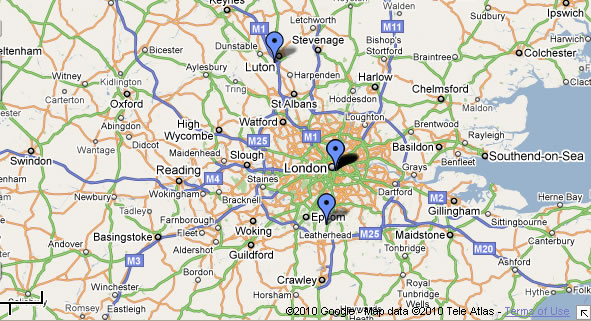
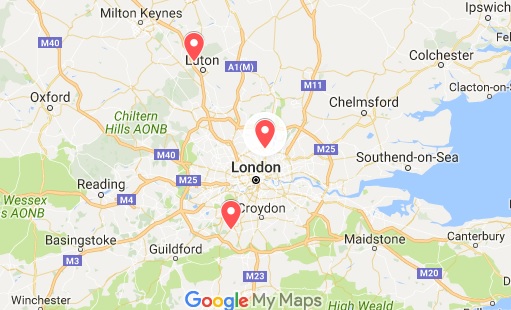
View branch details below
London, UK
Christian Pilgrims Church
Gospel Center
Queen Street off White Hart Lane
London. N17 8HX
info@christianpilgrimschurch.org
0208 808 5599 / 0795 621 70922
Luton, UK
Christian Pilgrims Church
clo St Luke's Churh Hall
Leagrave High Street Luton
Bedfordshire LU4 9JY
luton@christianpilgrimschurch.org
0158 252 9997 / 0795 691 2355
Epsom, UK
Christian Pilgrims Church
clo United Reform Church Hall
41 Church Street, Epsom
Surrey. KT17 1HX
epsom@christianpilgrimschurch.org
0137 272 9987 / 0783 212 0641
Lagos, Nigeria
Christian Pilgrims Church
7,Olawale Close off Adesina Street
Olusesi Bus-Stop Iju,
Lagos Nigeria.
We welcome and value your feedbacks and concerns. The best way to reach us is via email, phone or the social media.
In addition, below are other usefull contact details for feedbacks.
In addition, below are other usefull contact details for feedbacks.
 Contacting Us
For questions, feedbacks or concerns, you can reach us by phone or email, but before you do, please take a look at the sections below.
You may find that the answer to your question is already waiting for you there.
Re Frequently Asked Questions - FAQ
The FAQ tab contains answers to common questions asked. If you cannot find the answer to your question here, you can reach us below.
Re Church Branches
Christian Pilgrims Church has church branches which can be found within the UK and Africa. See our branch details page, and events to locate a church branch and its service times.
London, UK
Christian Pilgrims Church
Gospel Center
Queen Street off White Hart Lane
London. N17 8HX
info@christianpilgrimschurch.org
0208 808 5599 / 0795 621 70922
Luton, UK
Christian Pilgrims Church
clo St Luke's Churh Hall
Leagrave High Street Luton
Bedfordshire LU4 9JY
luton@christianpilgrimschurch.org
0158 252 9997 / 0795 691 2355
Epsom, UK
Christian Pilgrims Church
clo United Reform Church Hall
41 Church Street, Epsom
Surrey. KT17 1HX
epsom@christianpilgrimschurch.org
0137 272 9987 / 0783 212 0641
Lagos, Nigeria
Christian Pilgrims Church
Ikeja, Lagos
Nigeria.
Type Your Message and click Send...
Send Message...
Our Social Media Framework is a Work In Progress but fast on track...
We use socal media for different purposes including communication, contacts, prayers, outreach to name a few:
1. We have Skype Prayer Meetings
2. We colaborate and socialise on WhatsApp
3. We socialise and receive feedback on Facebook
4. Our Messages and ministrations can be viewed on YouTube
You can reach us on any of them by selecting from below option buttons. Reamin blessed